
‘Golden arches theory’ was meant to predict peace. It encouraged war
The West thought economic integration restrained aggression, while Russia thought it restrained any response to its aggression. Only the willingness to defend rules actually matters.
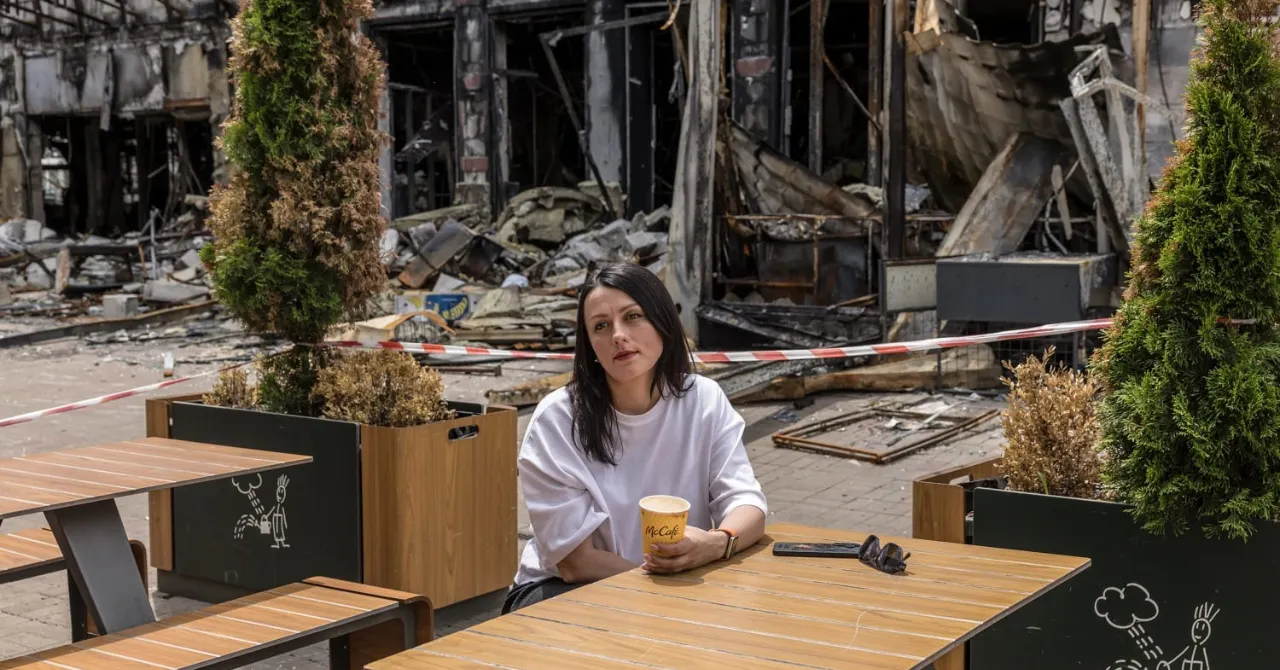
“When a country reaches a certain level of economic development, when it has a middle class big enough to support a McDonald's, it becomes a McDonald's country,” wrote New York Times columnist Thomas L. Friedman back in 1996, “and people in McDonald's countries don't like to fight wars; they like to queue for burgers.”
The Big Mac is mightier than the sword, thought Friedman, who long opposed to the Baltic countries joining NATO.
Fast forward to 2026 and the latest strikes directly on McDonald’s infrastructure in Ukraine, conducted by a country that had 847 McDonald’s restaurants, suggest that this ‘golden arches theory of conflict prevention’ is really not aging well.
‘Golden arches theory’ is still not aging well, as this McDonalds warehouse burns in Ukraine after a Russian attack.
— Baltic Takes (formerly badbaltictakes) (@Baltic_Takes) September 27, 2026
Let’s talk about this.
Thomas Friedman came up with the Golden Arches Theory of Conflict Prevention in the 90s, arguing that countries with McDonalds don’t fight…
But what if Friedman’s theory wasn’t just pointlessly naive, but dangerously so?
It influenced and reflected wider thinking that guided relations between the West and Russia in a way that arguably encouraged the latter to pursue its path of aggression. And there’s still a lot we must urgently learn from that.
Let’s back up.
Friedman’s ‘golden arches theory of conflict prevention’ was essentially a modern rebrand of the ‘capitalist peace’ tradition from the start of the century.
Influential writers such as Norman Angell, who published The Great Illusion in 1909, argued that modern states are so interconnected through trade that wars of conquest have become irrational.
This thinking proved popular in the early 1910s and then suddenly not popular from the mid-1910s onwards.
In fairness, Angell wasn’t saying that countries wouldn’t choose economic irrationality.
Undeterred by two subsequent world wars, Friedman was so proud of his own golden arches theory based on a firmer believe in economic rationality that he developed a whole book around it, released in 1999 with darkly comic timing.
Just as the first copies were being sent to reviewers, NATO intervened to halt ethnic violence directed from Belgrade, the very first place in the former communist world to start serving Big Macs a full eleven years earlier.
In response to the ongoing military campaign, Serbian mobs specifically attacked McDonald’s restaurants in Belgrade, all quite unhelpful to Friedman’s book launch happening at the same time.
Friedman initially defended his theory with some weak technical excuses about NATO not being a country and Yugoslavia being more of a civil war, so therefore none of it really counted.
Sensing he was losing the crowd with that one, Friedman decided to double down on his theory instead, arguing that the first war between McDonald’s countries actually proved his point exactly.
In the updated 2000 edition of his book, Friedman argued that Serbs faced a choice between “McDonald’s or Kosovo” and ultimately chose to remain integrated in the global economy rather than continue the fight. His updated argument was that global economic integration may not always prevent the rise of nationalist aggression, but it will at least curtail it.
But if Serbia could be plausibly characterised as some borderline case, Russia had it all from Friedman’s perspective.
Not just those 847 McDonalds, but a rapidly rising urban middle class with a growing taste for international goods and growing opportunities for foreign travel, an elite deeply invested in Western lifestyles, including with their holiday homes and children’s education, and all while their country was receiving extensive foreign direct investment and being integrated into international institutions.
“Russia experts” like Mark Galeotti hailed all this when pushing back against “hostile foreign commentators” who saw Russia as a threat, painting his own vivid picture of a country embracing coffee houses and the posh British supermarket Marks and Spencers.
Alas, all this proved insufficient to end Russia’s centuries-long tradition of brutally invading its neighbours.
Luka Safronov, son of the artist Nikas Safronov, handcuffed himself to the entrance of McDonald's. pic.twitter.com/WKjmPL9pgc
— NEXTA (@nexta_tv) March 13, 2022
Despite the passion of Luka Safronov chaining himself to a McDonalds, Russia’s population has been largely unable or unwilling to defend their lifestyle based on interconnections with a rules-based world.
Not those latte-sipping urban middle classes, not those Saint-Tropez-bathing elites, and not those on the periphery of the empire that actually do the bulk of fighting for Russia’s imperial wars.
McDonald’s closed all 847 of its restaurants in Russia, employing 62,000 people, during those first months of its full scale aggression against Ukraine. Meanwhile, Ukraine has opened about 40 more McDonald’s restaurants since then.
Several have come under direct attack, including the very first McDonalds opened in Kyiv, which has been damaged in at least nine Russian attacks. It’s described by NBC News as “the most bombed McDonalds in the world”, which is not a phrase Friedman ever predicted.
And, just this weekend, Russia struck a warehouse used by McDonald’s.
How did he get it all so wrong?
The year that Friedman first developed his theory, 1996, was the year McDonald’s expanded into its 100th country and was generating more revenue from outside the US for the first time.
If Friedman sounded prophetic in the 90s, it was only because McDonalds was slowly expanding into countries with relative stability at the time, while memories of Muscovites queuing for their first cheeseburgers were still seared into the minds of triumphant post-Cold War liberal thinkers.
Perhaps few people fit that description better than Francis Fukuyama, author of the much maligned The End of History and the Last Man.
Yet Fukuyama didn’t agree with Friedman on golden arches theory. Fukuyama argued that the requirements for a country getting investment from McDonald’s were too low to represent any kind of significant tipping point.
“I would not be surprised if in the next 10 years several of these McDonald's countries go to war with each other,” he said at the time (three years before several of these McDonald’s countries went to war with each other).
It’s not about McDonalds
Nevertheless, Golden Arches theory continued to take hold into the 21st century, just as it had a century earlier in the lead up to geopolitical catastrophe.
Friedman’s perspective was especially evident in Western policies toward Russia.
Russia’s integration into the global economy and international institutions, such as the G8 and WTO, became a high priority for the US beginning under the Clinton administration. Germany too advocated for Wandel durch Handel (“peace through trade”) with Russia.
The Russian side also seemed enthusiastic about this integration and how it could foster international peace. Putin even suggested that Russia should be admitted to NATO, as long as it was treated as “an equal partner” to NATO as a whole, which basically meant not going through an application process like all other members that would examine its commitment to good governance.
What many in the West didn’t realise was that Russia had a very different understanding of the peace that could be achieved from this kind of global integration. To Russia, peace is merely the lack of resistance.
While the West thought economic integration restrained aggression, Russia thought economic integration restrained any response to its aggression.
That’s clear from listening to strategic thinking and commentary on the Russian side from the 90s, as well as its increased attempts to use energy dependency as a weapon.
To Russia, the fact that “McDonalds countries” were unwilling to make sacrifices to fight also meant that they could be pushed around more easily.
It aligns with long-standing Russian doctrine to escalate when encountering weakness, as reflected in the maxim commonly attributed to Lenin: “Probe with bayonets. If you encounter mush, proceed; if you encounter steel, withdraw.”
The lack of a stronger international response to each escalation of Russian aggression, such as after Russia invaded Ukraine in 2014, only reinforced that assessment.
Friedman continued to stick by his golden arches theory, while also continuing to argue against NATO enlargement, seemingly not noticing that Russia was on the imperial warpath specifically against non-NATO countries, regardless of whether they had McDonalds or not.
It was only after Russia’s full scale invasion of Ukraine in 2022 that Friedman admitted he’d got things quite badly wrong.
He didn’t abandon golden arches theory, but he at least accepted that populations do not always prioritise cheeseburgers (and all that represents). Not when their own country launches an imperial war of aggression, as in Russia’s case, and not when their country finally realises they have to confront it, as in much of the West’s case.
“It was easy from afar to assume — and probably easy for Putin to assume — that eventually Europe would reconcile itself to the full-scale invasion Putin launched against Ukraine on Feb. 24, the way Europe reconciled with his 2014 devouring of Ukraine’s Crimean peninsula, a remote slice of land where he met little resistance and set off limited shock waves. Wrong, wrong, wrong.”
While Fukuyama is pilloried most for supposedly predicting the eternal triumph of liberalism, this is quite a mischaracterisation. He actually got a lot of it spot on. He argued liberal democracy had no convincing ideological competitor comparable to communism, but that didn’t make it inevitable.
Fukuyama pointed out that markets wouldn’t triumph without rule of law and sharply criticised Russia, even back in the 90s, for its authoritarian backsliding. He predicted that Russia would increasingly revert to authoritarianism because it had nothing better to offer. By 2013, Fukuyama was already warning that Russia would increasingly turn to aggression, especially against Ukraine, because it could not tolerate successful countries highlighting its own failures.
Fukuyama’s predictions are so interesting because he makes them before those things happen, unlike most “Russia experts” like Galeotti and foreign policy experts like Friedman who are constantly updating their predictions after they get things wrong to explain why the thing that did actually happen was inevitable and totally aligned with their analysis if only you interpreted it totally differently.
The key difference is that Fukuyama examined the enforcement of rules and the quality of institutions, while the likes of Friedman were focused on surface-level vibes while ignoring the louder drumbeat of war.
The world learned the hard way a century ago that interconnections are not enough to curtail aggression, especially if the other side interprets it as a form of weakness in the way Friedman so naively signalled.
The willingness to stand firm on values and act in defence of rules is what matters most.


